In Search of Fun Robots
Better Question: When does efficiency destroy value?
As the metal ball starts to climb, Fender asks Rodney Copperbottom a question: “First time on the Cross-Town Express?”
From Fender’s bodily reaction and “ooo-wee,” we can tell that this will be an experience to remember.
That’s because the Crosstown Express has more in common with a roller coaster than it does with our real-world inner-city transit systems.
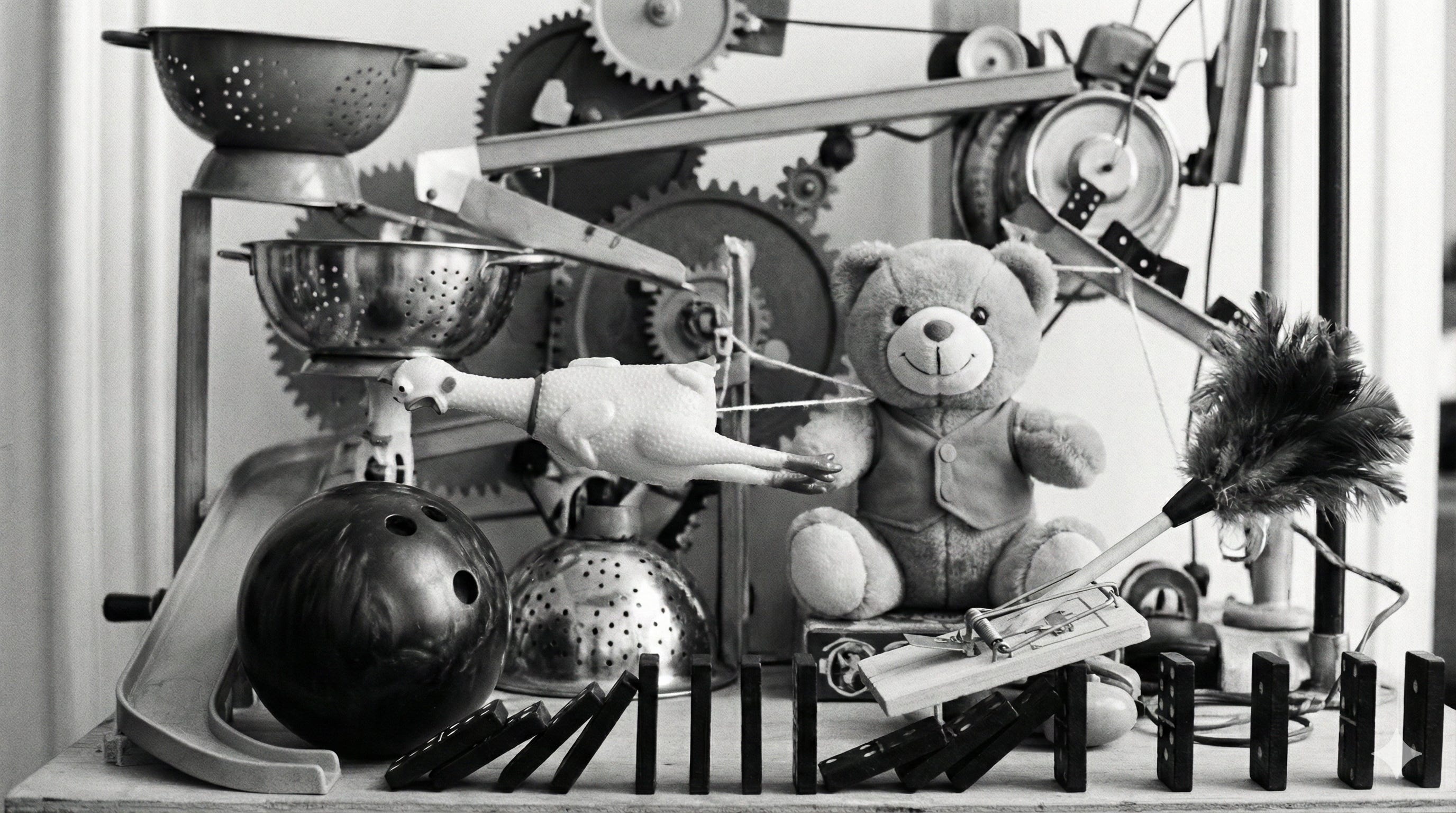
If you aren’t familiar with the movie Robots, the Cross-Town Express pays homage to a Rube Goldberg machine, a contraption that solves a simple problem in the most ridiculously inefficient way possible.
Rather than riding a subway in a straight line, Fender and Rodney move through the city like a giant ping pong ball.
Imagine that as your daily commute.
Alas, that’s unlikely to happen.
So much of our world has been designed with one thing top of mind: efficiency.
.
When does efficiency destroy value?
What ultimately drives the relentless focus on efficiency is a goods-centric understanding of the economy. When we think of goods, we think in terms of inputs to outputs. The more efficiently you can turn inputs to outputs, the more you can increase your profit margin to make more money, decrease your price to reach a wider market (and make more money), or some combination thereof.
I don’t want to dump on our friend efficiency. There’s much positive to be said about it. For one, if it weren’t for our ruthless focus on efficiency, far less would be accessible. We’d also use far more fuel which has effects beyond price, and the people involved would expend more energy. Who wouldn’t want to make back-breaking work less, well, back-breaking?
Like any good thing, when efficiency is taken too far, it becomes a vice. Like flattening our world into sameness:
We make furniture using cookie cutters so that it can be produced and shipped as efficiently as possible. That efficiency has gone all the way to removing the step of actually putting the furniture together — the buyer now supplies that labor, cursing and all.
We see roughly 3.5 distinct car silhouettes because car makers all strive to be the most fuel efficient as well as production efficient, compounding the effect.
Our advertising uses the same stock models because it’s been more efficient to pull from a stock library than to hire a photographer to conduct a proper photoshoot that would result in something unique.
And thus, our world couldn’t be further from the one Rube Goldberg1 imagined. He celebrated the absurd, the whimsical, and the human tendency to imagine beyond the purely practical.
By prioritizing efficiency, we risk losing the wonder, humor, and ingenuity that make invention meaningful — not just as a means to an end, but as an expression of human curiosity and spirit.
And when we lose that, we strip out a rich layer of value.
Here’s how to put it into practice →
Companies push us to automate our way to bliss. But for those of us looking to live a vital life, we have to ask: at what point does efficiency destroy value?
If you find joy in the act of cooking, having your meals delivered destroys that value. If you find organizing your notes after a meeting helps you retain the information (like me), having AI take your notes destroys that value.
For businesses, the tension is more palpable. Rather than viewing efficiency as the ultimate goal, we can choose to see it as an opportunity. Asking, “When does efficiency destroy value the people we serve would appreciate?” allows us to consider where it may be strategic to de-proritize efficiency.
To know exactly where or how, we can then ask additional questions, like:
Where would being less efficient allow us to build a genuine human relationship?
Where would being less efficient allow us to add distinction that resonates at an identity level?
Where would being less efficient surprise or delight the people we serve?
Rodney and Fender’s dizzying trip across Robot City gives us a glimpse into their world, revealing that delivering value does not exist only on a practical plane.
Quite the contrary.
Seeing a need and filling a need efficiently is one thing. Doing it in a way that’s unexpected, distinct, or delightful?
That’s where the richness lives.
.
Hi! I’m Katie
In addition to writing this newsletter, I speak, cultivate a community, and work directly with teams. Here’s how you can work with me:
Speaking: Bring me in to challenge assumptions and explore frameworks to think more strategically.
Community: Join The Glaede, a space for those who find deep thinking fun.
Direct: Work with me 1-on-1 at Point:Value to ask the right questions and evolve your value.
.
Rube Goldberg was a Pulitzer Prize-winning American cartoonist, an inventor and innovator, and the only person whose name is an adjective in Merriam-Webster’s Dictionary.